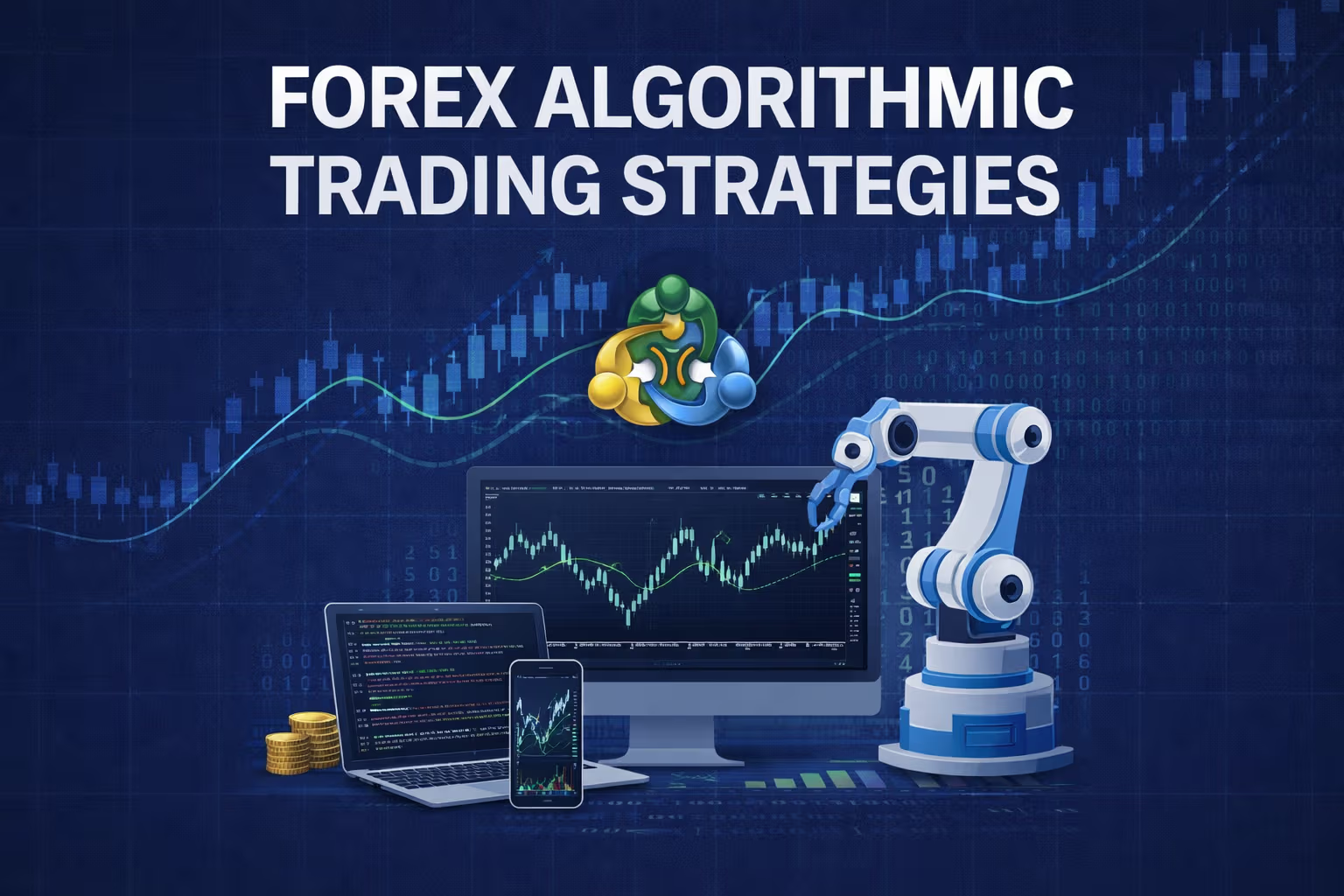
The art of writing code is now as widespread in Singapore’s trading community as reading a candlestick chart used to be. It has been a gradual, yet undeniably noticeable, change that has been brought about by a generation of professionals equally at home in a terminal window as they are on a trading platform. To this group, the attraction of algorithmic methods is not the elimination of human judgment, but rather its expression in a way that is both consistent and rapid to a degree that cannot be faithfully performed by manual trading.
The basis of most algorithmic strategies worth considering is backtesting. Practitioners invest significant time testing their logic on past price data before a single line of live code can execute against real capital and see whether the strategy performs as intended across diverse market conditions. Singapore traders who pursue this process seriously take backtesting results with due caution as they know that overfitting a strategy to historic data gives a flashy result that would fail miserably when subjected to live markets. That distinction separates the serious practitioners from those who pursue curve-fitted outcomes.
The presence of APIs in retail platforms has been a significant development for the technically oriented trading fraternity in Singapore. MAS licensed brokers have increasingly made their infrastructure algorithmically accessible, enabling traders to directly interface their custom-built systems with execution engines without human intervention. It is no longer an unusual sight to find a data scientist from a technology company in one-north running a mean-reversion strategy in currency pairs during Singapore market hours. The wall between professional quantitative practice and advanced retail trading has narrowed considerably.
The absence of risk management in CFD trading using automated systems presents risks of a different kind than those faced by manual traders. A runaway strategy can accumulate losses at a faster rate than any human operator could prevent if the market gets into a regime the algorithm was not meant to handle. Singapore traders using automated systems tend to incorporate circuit breakers, maximum drawdown thresholds and position caps that stop trading when conditions shift beyond predetermined limits. Those protections are not add-ons but are part and parcel of any well-designed and properly deployed algorithmic strategy.
Python has become the language of choice among the retail algorithmic traders of Singapore, in part due to the breadth of financial libraries and in part due to the prevalence of the language in the professionally related data science and technology disciplines which many of these traders continue to practice. Statistical analysis, backtesting frameworks and broker API connectivity libraries have significantly lowered the barrier to entry. A moderately skilled programmer who has a real understanding of the market can now create and implement a workable systematic strategy using tools that are free and well-documented.
The use of machine learning has also been brought up in the discussion, but seasoned professionals are usually cautious about their predictions. The idea of pattern recognition on large price datasets can be very alluring on paper, however, financial time series are notoriously noisy, and even models that perform well in training are often unable to generalise to new data. Singapore traders who have tried predictive models tend to conclude that simpler rule-based models, whose logic they can easily understand, are better than complex models whose behaviour they can hardly decipher when something goes awry.
The exchange of knowledge within communities has contributed to the speed at which algorithmic practice is developed among the Singaporean retailers. There are private groups that focus on systematic trading where people exchange code, talk about their results, and critique the methodologies of one another at a level of rigor comparable to professional research settings. The result of such a culture of teamwork has improved the quality of retail algorithmic work overall in the city. The traders who have advanced CFD trading via systematic methods are building on each other’s work and the aggregate impact on how the community interacts with markets has been subtle but meaningful.